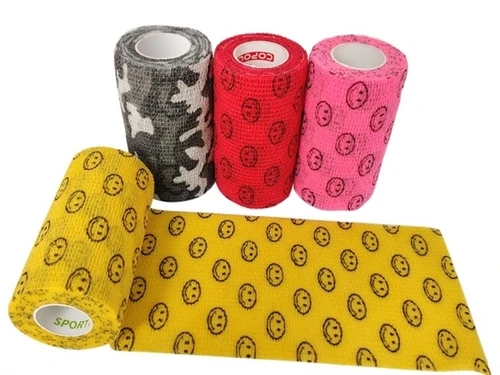
Cohesive bandages have become an essential tool in wound care, sports medicine, and veterinary practice. Unlike traditional adhesive tapes, cohesive bandages stick to themselves rather than to skin or hair, offering secure fixation with improved comfort. In recent years, nonwoven cohesive bandage materials have gained popularity due to their lightweight structure and enhanced breathability.
Among these products, GSP nonwoven cohesive bandage has been developed to emphasize comfort, ease of use, and adaptability. Key features include no sticking to hair or skin, easy hand tear, high elasticity, and a breathable, lightweight construction. To understand its value more clearly, it is helpful to compare GSP nonwoven cohesive bandage with other well-known brands on the market, such as products from 3M and Andover Healthcare.

A nonwoven cohesive bandage is a self-adhering wrap made from nonwoven fabric rather than traditional woven cotton or elastic cloth. The cohesive coating allows the bandage to bond to itself without glue or clips. Because the adhesive does not contact the skin directly, the bandage can be removed painlessly and without leaving residue.
Nonwoven materials are produced by bonding fibers together through mechanical, thermal, or chemical processes rather than weaving. This structure creates a fabric that is lighter, more breathable, and more uniform in texture. These properties are particularly useful in compression, support, and fixation applications where airflow and flexibility matter.
Core Features of GSP Nonwoven Cohesive Bandage
GSP nonwoven cohesive bandage is designed around four main performance characteristics.
First, it does not stick to hair or skin. This is especially important for veterinary use and for patients with sensitive skin. Removal is smoother and less traumatic compared with adhesive tapes.
Second, it is easy to tear by hand. Clinicians and users do not need scissors, which improves speed and convenience during application. This also reduces contamination risk in emergency or field settings.
Third, it offers high elasticity. The bandage can stretch and conform to joints, muscles, and irregular contours while maintaining consistent support. Elastic recovery allows it to stay in place during movement.
Finally, it is breathable and lightweight. The nonwoven structure allows air to circulate, helping reduce moisture buildup and improving overall comfort during prolonged wear.
These design elements form the basis for comparing GSP nonwoven cohesive bandage with other cohesive bandage brands.
Comparison with Traditional Elastic Cohesive Bandages
Many cohesive bandages on the market are made from woven or knitted elastic fabrics. These materials provide strength and compression but can be heavier and less breathable. When used for extended periods, they may trap heat and moisture, which can irritate the skin or slow healing.
In contrast, the nonwoven structure of GSP cohesive bandage reduces overall weight while maintaining elasticity. This makes it more suitable for applications where comfort and airflow are priorities, such as wrapping fingers, ankles, or animal limbs.
Traditional elastic cohesive bandages also tend to have a tighter fiber structure. While this improves durability, it may reduce flexibility on small or highly mobile body parts. GSP's nonwoven design adapts more easily to complex shapes without excessive bulk.
GSP vs 3M Cohesive Bandage Products
3M is widely recognized for its cohesive bandage solutions used in hospitals and clinics worldwide. These products are known for reliable self-adherence and stable compression.
However, many 3M cohesive wraps use elastic woven fabrics optimized for moderate compression and durability. While effective, they can feel thicker and warmer during long-term wear. GSP nonwoven cohesive bandage, by contrast, emphasizes breathability and lightness. This makes it particularly suitable for patients who require fixation rather than strong compression, or for situations where frequent rewrapping is necessary.
Another difference lies in texture. Nonwoven materials have a softer surface feel, which can be beneficial for fragile or inflamed skin. In comparison, woven elastic wraps may feel firmer and slightly abrasive over time.
GSP vs Andover Healthcare CoFlex-Type Bandages
Andover Healthcare produces well-known cohesive bandages widely used in both human and veterinary medicine. These bandages are valued for their strong self-adherence and wide color and pattern selection.
While these products perform well in terms of cohesion and elasticity, they are generally thicker and more compression-oriented. GSP nonwoven cohesive bandage positions itself differently by focusing on lightweight fixation and comfort rather than maximum compression.
For veterinary use in particular, the no-stick-to-hair property of GSP's nonwoven bandage is a key advantage. Animals often have dense fur, and removing adhesive or semi-adhesive wraps can be stressful and painful. A nonwoven cohesive bandage that releases easily helps reduce handling time and animal discomfort.
Breathability and Moisture Control
One of the most important differences between nonwoven cohesive bandages and traditional elastic wraps is breathability. Nonwoven fabrics contain microscopic gaps between fibers, allowing heat and moisture to escape.
In clinical practice, moisture accumulation under a bandage can lead to maceration of the skin and increased infection risk. GSP nonwoven cohesive bandage helps minimize this issue by promoting airflow. Compared with heavier elastic wraps from other brands, it offers a more balanced microclimate for the skin.
This is particularly beneficial in warm environments, during physical activity, or for animals with thick coats, where overheating under bandages can be a concern.
Ease of Application and Removal
Ease of use is a major factor in bandage selection. GSP nonwoven cohesive bandage can be torn by hand, allowing quick application without tools. This is comparable to many leading brands, but the lighter fabric of GSP makes it easier to control tension during wrapping.
Because it does not adhere to skin or hair, removal is straightforward. In contrast, some cohesive bandages with stronger surface coatings may partially bond to hair or dried exudate, making removal less comfortable.
For caregivers and veterinary professionals, faster application and gentler removal translate into improved workflow and reduced stress for patients or animals.
Nonwoven cohesive bandages are used in a wide range of scenarios, including:
Securing wound dressings
Providing light compression
Supporting sprains or strains
Fixing splints or padding
Veterinary limb and tail wraps
GSP nonwoven cohesive bandage performs well in all these applications due to its elasticity and cohesive coating. Compared with heavier bandages from other brands, it is better suited for small or delicate areas such as paws, digits, or joints.
Its lightweight nature also makes it practical for repeated use in training, sports recovery, or animal care routines where bandages may need to be changed frequently.

Durability and Cost Efficiency
Durability is another factor in comparing cohesive bandage brands. Woven elastic wraps tend to be more resistant to tearing but may lose elasticity after repeated stretching. Nonwoven bandages, while slightly less rugged, maintain consistent performance for their intended duration of use.
GSP nonwoven cohesive bandage balances durability with comfort. It is strong enough for secure fixation while remaining easy to tear and conform. This balance can lead to reduced material waste and more efficient use per roll.
When compared with premium cohesive bandages from global brands, GSP offers a competitive alternative for clinics and distributors seeking cost-effective solutions without sacrificing functional performance.
Why GSP Nonwoven Cohesive Bandage Stands Out
When viewed alongside other brands, GSP nonwoven cohesive bandage distinguishes itself in several areas:
Non-stick to hair or skin for painless removal
Easy hand tear for faster application
High elasticity for anatomical conformity
Breathable and lightweight for improved comfort
Suitable for both human and veterinary use
While leading brands such as 3M and Andover Healthcare offer proven cohesive bandage products, GSP's focus on nonwoven technology provides a different balance of softness, airflow, and adaptability.
Conclusion
Cohesive bandages are no longer defined solely by their ability to stick to themselves. Material choice, breathability, and user comfort now play equally important roles. In this context, nonwoven cohesive bandages represent a modern evolution of traditional wraps.
GSP nonwoven cohesive bandage demonstrates how thoughtful material design can enhance everyday medical and veterinary care. Compared with other brands that emphasize heavier elastic fabrics and stronger compression, GSP offers a lighter, more breathable, and more user-friendly alternative.
For practitioners and distributors seeking a cohesive bandage that combines self-adherence, comfort, and versatility, GSP nonwoven cohesive bandage stands as a compelling option in an increasingly competitive market.